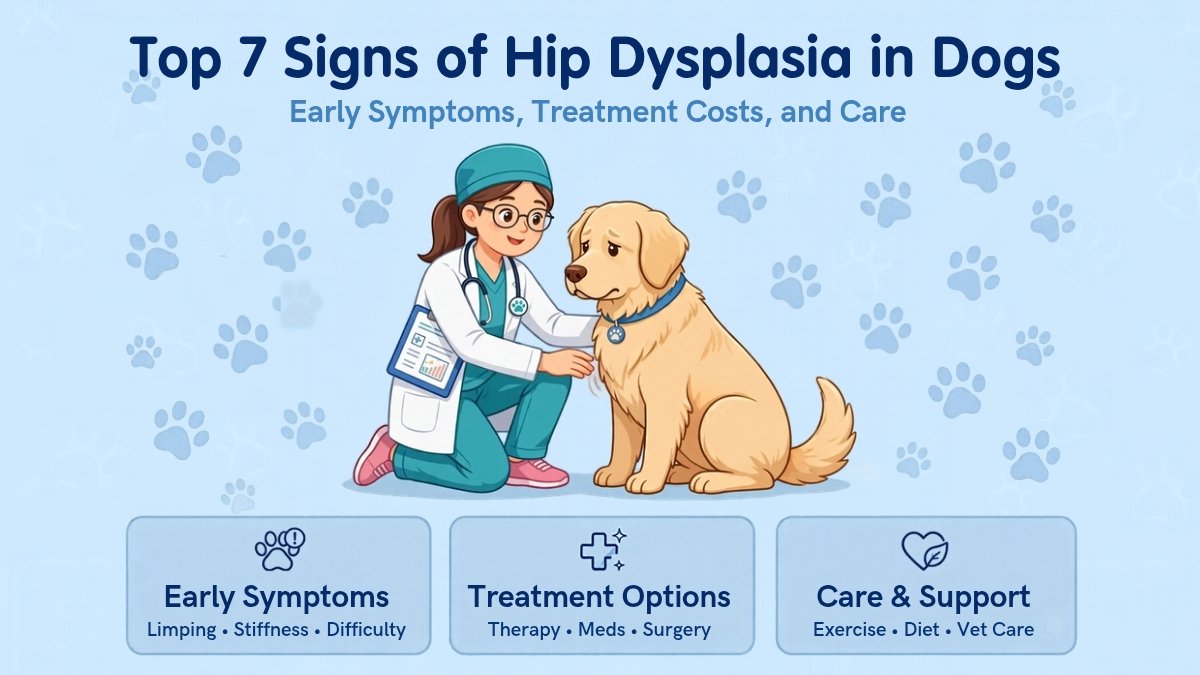
I will never forget the first time I saw it. My cousin’s German Shepherd, Rocky, was 7 months old. He was trying to get up from the floor after a nap, and his back legs just… wobbled. He did this weird bunny hop thing to get up. We all laughed and said “sleepy boy.” It was not sleepy boy. It was hip dysplasia.
If you have a big dog – Lab, German Shepherd, Golden, Rottweiler – you need to know these signs. Because I learned the hard way, the earlier you catch it, the more money and pain you save.
This is not a vet textbook. This is what I, my cousin, and our vet actually saw in real life.
What Even Is Hip Dysplasia? In Simple Words
Imagine the hip is a ball and a socket. Like a spoon in a bowl. In a normal dog, the ball fits tight and smooth in the bowl.
In a dysplasia dog, the bowl is too shallow. The ball keeps slipping, grinding, clicking. Over months, it causes arthritis, pain, and that dog can’t run properly.
It’s mostly genetic, but weight, too much exercise as a puppy, and slippery floors make it way worse.
The Top 7 Signs I Wish I Knew Earlier
1. The Bunny Hop Run – The Biggest Red Flag
This is the number one sign. When Rocky ran fast, he didn’t run like normal dogs, left-right-left-right. He hopped with both back legs together, like a bunny.
If your dog does bunny hops when running up stairs or in the park, that is not cute. That is his body trying to avoid pain by using both legs together. I see this in almost every dysplasia video on Instagram.
2. Struggling to Get Up After Sleeping or Sitting
This was Rocky’s first sign. After lying down for 30 minutes, he would take 10-15 seconds to get up. His back legs looked stiff. He would moan a little.
In the morning it was worse. Like old people with joint pain. If your puppy acts like an 80-year-old man in the morning, get it checked. Young dogs should pop up instantly.
3. Clicking or Popping Sound From Back Legs
I actually heard it. When Rocky walked past me, I heard a soft click from his hip. I thought it was his nails on floor.
My vet said that click is the ball slipping out of the socket. Not every dog makes sound, but if you hear a pop or click when they walk, that’s not normal.https://petkingdom.site/dog-acl-surgery-cost-breakdown/
4. One Leg Gets Skinny – Muscle Loss
This one shocked me. After 2 months, Rocky’s back legs looked thin. Like chicken legs. While his chest and front legs were super muscular.
Why? Because he stopped putting weight on his painful back legs. So he uses his front legs to pull himself. Front becomes bulky, back becomes skinny. Look at your dog from behind. If his thighs look thin compared to front, it’s a bad sign.
5. Not Wanting to Climb Stairs or Jump in Car
Rocky LOVED car rides. Suddenly he would stand in front of the car and stare at me. He didn’t want to jump in. Same with stairs – he would go halfway and stop.
It’s not laziness. It hurts to push up with bad hips. If your dog who used to jump on your bed now hesitates or needs help, listen to him. He is telling you it hurts.
6. Sitting Weird – The Lazy Sit or Frog Sit
Normal dogs sit square, knees bent. Dysplasia dogs do a “lazy sit” – legs kicked out to one side. Or they lie like a frog, back legs splayed flat behind them.
Rocky always sat with both legs to the left side. We thought it was funny. Vet said that sitting straight hurts, so they shift weight. If your dog never sits straight, ever, check his hips.
7. Limping After Play But Fine After Rest
This is the tricky one. Rocky would play hard for 20 minutes in park, then limp badly for an hour. After sleeping at night, next morning he was fine again. So we thought it’s just tiredness.
No. That on-and-off limp after exercise is early arthritis from dysplasia. It comes and goes in the beginning. Later it becomes constant.
How Much Does Treatment Cost? Real Numbers
Okay, let’s talk money because my cousin paid it all last year. So these are real US prices, not Google estimates.
- X-rays and Diagnosis: $200 – $500
They need to sedate your dog to get proper hip X-rays. They will check the angle. This is the first step.
If It’s Mild – No Surgery:
This is where most dogs stay if caught early.
- Joint supplements (Dasuquin, Cosequin): $30 – $60 per month, for life
- Pain meds (Meloxicam, Galliprant): $40 – $100 per month
- Weight management food: $20 extra per month
- Physiotherapy / Water treadmill: $50 – $100 per session
- Non-slip rugs, orthopedic bed, ramp: $150 – $300 one time
My cousin spends about $90 a month now. No surgery yet.
If It’s Severe – Surgery Costs:
- FHO Surgery (Femoral Head Ostectomy): $1,500 – $3,500 per hip. They remove the ball. Best for small dogs and medium dogs under 25kg. Dog lives without a ball joint, muscle makes a fake joint.
- Double or Triple Pelvic Osteotomy (DPO/TPO): $2,000 – $4,500 per hip. Only works if puppy is under 10 months and caught super early. They cut pelvis and rotate socket. Can fix it permanently if done early.
- Total Hip Replacement (THR) – The Big One: $5,000 – $8,000 per hip. This is like human hip replacement, titanium hip. If you have a big dog like German Shepherd or Labrador and want him to run like normal again, this is gold standard. Expensive but life changing.
Rocky’s vet said if his hips get worse, he will need FHO. We are trying to avoid it with weight control.
What You Can Do at Home Right Now – What Actually Helped Rocky
This is what our vet told us and it actually worked.
- Keep Him Skinny. This is the number one thing. Every extra kg on a dysplasia dog is like 4kg of pressure on hips. Rocky lost 4kg. He moves 50% better now. No table scraps. No extra treats.
- No Slippery Floors. We put cheap yoga mats and rugs everywhere. On tiles, his legs would slip and grind his hips. Since rugs, no more slipping.
- No Jumping and No Long Runs. No more ball chasing for an hour. Now it’s 10-minute slow walks, 2 times a day. And swimming! Swimming is magic. It builds muscle without weight on hips. Rocky swims twice a week in summer.
- Orthopedic Bed. We bought a $70 memory foam bed from Amazon. Before he slept on floor and woke up stiff. Now he sleeps on bed and gets up much faster.
- Warm Compress in Winter. In cold, his hips get worse. We put a warm towel on his hips for 10 minutes in morning. He loves it and it loosens him up.
When to Rush to Vet?
Don’t wait like we did. Go to vet this week if:
- Your puppy bunny hops even once or twice
- He struggles to get up for more than 2-3 days in a row
- You hear clicking from hips
- He doesn’t want to do stairs he used to do easily
Ask for “PennHIP X-ray” or “OFA X-ray”. Regular X-ray sometimes misses early dysplasia.
I wish someone told me about bunny hop when Rocky was 5 months old. We would have started supplements and weight control way earlier. Now we are managing it, but we could have slowed it down much better.
Don’t ignore the weird sit. Don’t ignore the slow mornings. Your dog can’t say “my hips hurt.” He shows you.
FAQs – What Everyone Asks Me About Rocky Now
At what age does hip dysplasia show up?
In Rocky’s case, 6-7 months. Most big breed dogs show signs between 5 to 12 months when they grow super fast. But some dogs hide it until they are 2-3 years old when arthritis starts. If your dog is a large breed, watch him closely in first year.
Can hip dysplasia go away on its own?
No. The socket shape won’t fix itself. But you can manage it so well that dog lives a normal life without surgery. With weight control, supplements, and swimming, many mild dogs never need surgery. Rocky’s vet said mild cases can live happily till 10+ years without operation.
Is my dog in a lot of pain? He still wants to play.
Yes, but dogs hide pain. They will still wag tail and try to play because they love you. That limp after play is pain. The slow getting up is pain. Just because he is not crying does not mean it’s not hurting. I learned that from our vet.
Can I still let my dog run and play?
Short, slow play yes. Long, crazy running and jumping no. Think of it like a human with bad knees – you can walk and swim, but you shouldn’t run a marathon every day. 15-20 minute sniff walks are better than 1 hour fetch. And stop if he starts limping.
Should I breed my dog if he has hip dysplasia?
Please don’t. This is strongly genetic. If Rocky has it, his puppies have a super high chance of having it too. Even if he is a beautiful German Shepherd. Responsible breeders get OFA hip tests before breeding. That’s how we reduce this disease.
1 thought on “Top 7 Signs of Hip Dysplasia in Dogs: Early Symptoms, Treatment Costs, and Care”